
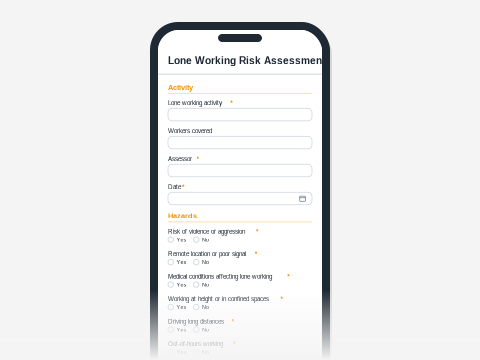
Lone Working Risk Assessment template
Assess the risks of a lone working activity: location, violence, medical, communication, check-in and emergency arrangements.
Opens in a free trial with this form ready to use.
Download printable PDF (57 KB)HSE INDG73 Protecting lone workers
This template is provided as a starting point only. pro-Forms accepts no liability for the accuracy or suitability of its forms. Check every form with a suitably qualified person before using it in a live environment.
About this template
Assess the risks of a lone working activity: violence or aggression, remote locations or poor signal, medical conditions, work at height or confined spaces, long drives, out-of-hours work and handling cash.
Then set the controls: the check-in method and frequency, what happens if a check-in is missed, other measures and the residual risk.
Review the assessment when the work, location or worker changes, and after any incident or missed check-in, so the controls stay matched to the real risks.
What's on this form
Every field in the template, grouped as it appears on the phone. Required fields are marked *.
1. Activity
- Lone working activity * Text
- Workers covered Text
- Assessor * Text
- Date * Date
2. Hazards
- Risk of violence or aggression * Yes / No Choice
- Remote location or poor signal * Yes / No Choice
- Medical conditions affecting lone working * Yes / No Choice
- Working at height or in confined spaces * Yes / No Choice
- Driving long distances * Yes / No Choice
- Out-of-hours working * Yes / No Choice
- Handling cash or valuables * Yes / No Choice
3. Controls
- Check-in method * Phone call / App check-in / Lone worker device / Buddy system Choice
- Check-in frequency Text
- Escalation if a check-in is missed * Paragraph
- Other controls Paragraph
- Residual risk * Low / Medium / High Choice
4. Sign-off
- Additional comments Paragraph
- Assessor name * Text
- Assessor signature * Signature
- Date signed * Date
Questions about this template
Is any work too risky to do alone?
Some is. Work in confined spaces, near exposed live conductors and some high-risk tasks usually need at least two people.
What check-in methods are there?
Phone or text check-ins, a check-in form, lone worker apps and devices with alarm buttons and GPS.
Why plan for a missed check-in?
A check-in system only works if someone acts when a check-in is missed. Set who follows up and how quickly.
More Energy & Environmental templates
All 11 templates →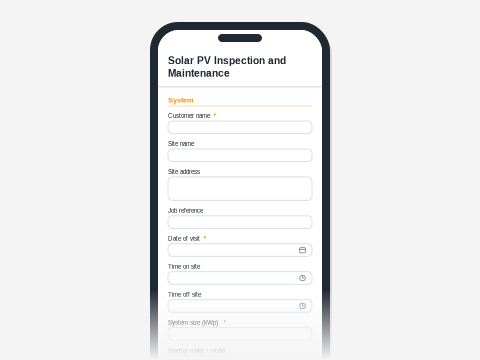 Solar PV Inspection and Maintenance
Periodic inspection of a solar PV system: array condition, DC isolators, inverter, string readings and generation.
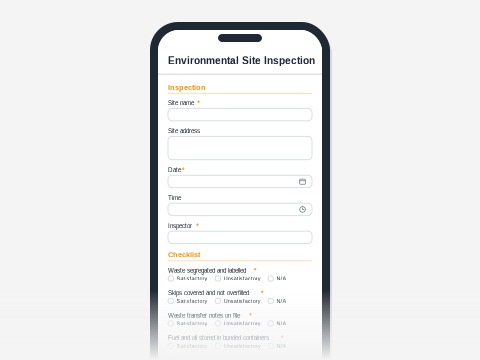 Environmental Site Inspection
Routine environmental inspection of waste, storage, drainage, spill kits, emissions, noise and dust on site.
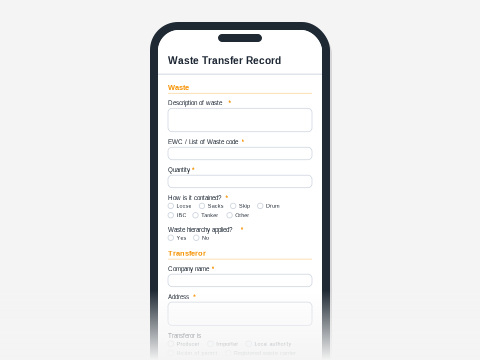 Waste Transfer Record
Records the information a waste transfer note must contain: waste description, EWC code, containment, transferor and transferee details.
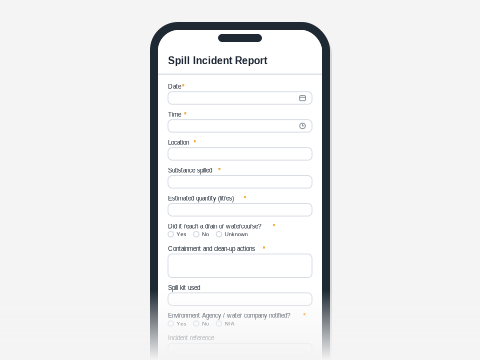 Spill Incident Report
Record an oil, fuel or chemical spill: substance, quantity, containment, any drain or watercourse impact and notification.