Fire Risk Assessment template
Structured fire risk assessment: ignition sources, fuel, people at risk, means of escape, detection, management and action plan.
Opens in a free trial with this form ready to use.
Download printable PDF (115 KB)Regulatory Reform (Fire Safety) Order 2005; Fire Safety Act 2021
This template is provided as a starting point only. pro-Forms accepts no liability for the accuracy or suitability of its forms. Check every form with a suitably qualified person before using it in a live environment.
About this template
A structured fire risk assessment for a building. Record the premises, responsible person, use, floors, occupancy and the people at risk, then assess fire hazards (ignition sources, smoking, arson, heating, cooking, hot work, combustibles, housekeeping and dangerous substances) and fire protection (escape routes, fire doors, signage, emergency lighting, detection, extinguishers and compartmentation).
The management section covers the emergency plan, training, drills, alarm tests, maintenance records and PEEPs. Findings go into an action plan with priorities, owners, target dates and photos, followed by an overall risk level and review date.
What's on this form
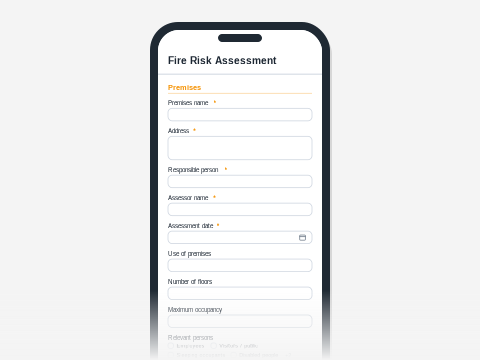
Every field in the template, grouped as it appears on the phone. Required fields are marked *.
1. Premises
- Premises name * Text
- Address * Paragraph
- Responsible person * Text
- Assessor name * Text
- Assessment date * Date
- Use of premises Text
- Number of floors Text
- Maximum occupancy Text
- Relevant persons Employees / Visitors / public / Sleeping occupants / Disabled people / Lone workers / Young persons Tick boxes
2. Fire hazards
- Electrical sources of ignition controlled * Yes / No / N/A Choice
- Smoking controlled * Yes / No / N/A Choice
- Arson risk controlled * Yes / No / N/A Choice
- Heating appliances safe * Yes / No / N/A Choice
- Cooking safely managed * Yes / No / N/A Choice
- Hot work controlled * Yes / No / N/A Choice
- Combustible storage managed * Yes / No / N/A Choice
- Housekeeping satisfactory * Yes / No / N/A Choice
- Dangerous substances controlled * Yes / No / N/A Choice
3. Fire protection
- Escape routes clear and adequate * Yes / No / N/A Choice
- Fire doors in good condition and self-closing * Yes / No / N/A Choice
- Escape signage adequate * Yes / No / N/A Choice
- Emergency lighting adequate * Yes / No / N/A Choice
- Fire detection and alarm adequate * Yes / No / N/A Choice
- Fire extinguishers suitable and serviced * Yes / No / N/A Choice
- Compartmentation intact * Yes / No / N/A Choice
4. Management
- Emergency plan in place * Yes / No / N/A Choice
- Staff fire training up to date * Yes / No / N/A Choice
- Fire drills carried out * Yes / No / N/A Choice
- Weekly alarm tests recorded * Yes / No / N/A Choice
- Maintenance records kept * Yes / No / N/A Choice
- PEEPs in place where needed * Yes / No / N/A Choice
5. Action plan repeats as needed
- Issue found * Paragraph
- Priority * Low / Medium / High / Immediate Choice
- Action required * Paragraph
- Responsible Text
- Target date Date
- Photo Photo
6. Conclusion
- Overall risk level * Trivial / Tolerable / Moderate / Substantial / Intolerable Choice
- Next review date * Date
- Additional comments Paragraph
- Assessor name * Text
- Assessor signature * Signature
- Date signed * Date
Questions about this template
Who must carry out a fire risk assessment?
The responsible person for the premises, usually the employer or whoever controls the building. If they lack the skills, they must appoint a competent person to do it.
Does the fire risk assessment have to be written down?
Yes. Since 1 October 2023, every responsible person in England and Wales must record the full fire risk assessment, whatever the size of the business.
How often should it be reviewed?
Regularly, and whenever there is a significant change to the building, its use or the people in it. Many organisations review annually.
More Fire & Security templates
All 11 templates →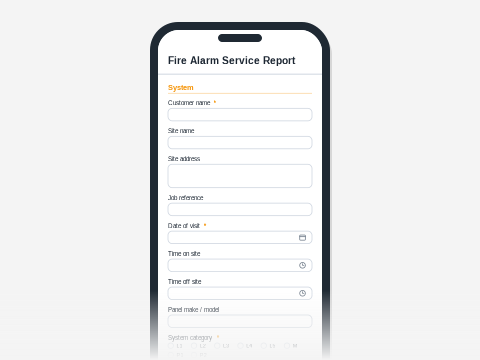 Fire Alarm Service Report
Periodic inspection and service of a fire detection and alarm system: panel, batteries, detectors, call points and sounders.
 Fire Extinguisher Inspection
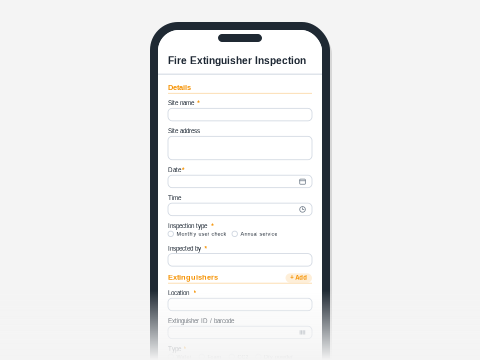
Monthly or annual extinguisher check: location, type, pressure, seals, damage and service date for each unit.
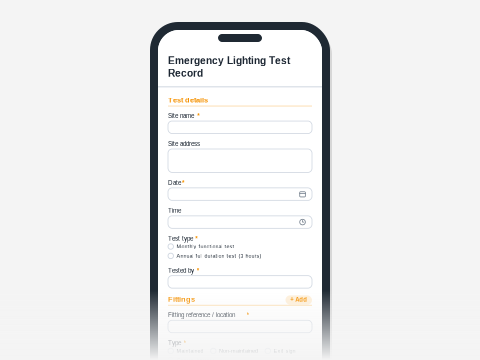 Emergency Lighting Test Record
Record monthly functional flick tests and annual 3-hour duration tests of emergency lighting fittings.
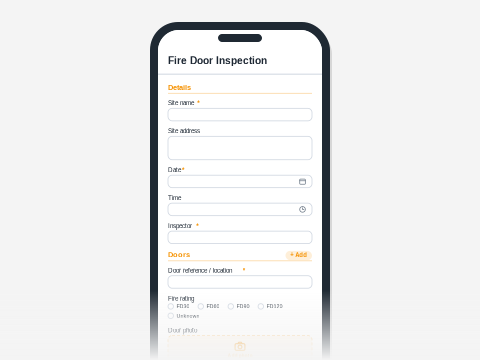 Fire Door Inspection
Door-by-door fire door check: leaf, frame, gaps, seals, hinges, self-closer, signage and glazing.