
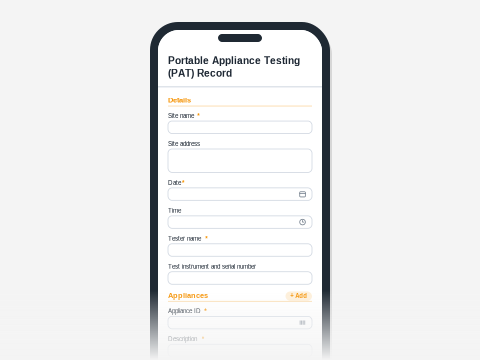
Portable Appliance Testing (PAT) Record template
Appliance-by-appliance PAT record: ID, class, visual inspection, earth continuity, insulation resistance and result.
Opens in a free trial with this form ready to use.
Download printable PDF (71 KB)Electricity at Work Regulations 1989; IET Code of Practice for In-service Inspection and Testing
This template is provided as a starting point only. pro-Forms accepts no liability for the accuracy or suitability of its forms. Check every form with a suitably qualified person before using it in a live environment.
About this template
An appliance-by-appliance PAT record. Note the site, tester and test instrument, then for each appliance record its ID, description, location and class, the formal visual inspection, earth continuity, insulation resistance and protective conductor or touch current readings.
Each appliance gets a pass or fail result, the next test date and any fault notes, giving you an asset register of portable equipment as you go.
What's on this form
Every field in the template, grouped as it appears on the phone. Required fields are marked *.
1. Details
- Site name * Text
- Site address Paragraph
- Date * Date
- Time Time
- Tester name * Text
- Test instrument and serial number Text
2. Appliances repeats as needed
- Appliance ID * Barcode scan
- Description * Text
- Location Text
- Class * Class I / Class II / Class III Choice
- Formal visual inspection * Pass / Fail / N/A Choice
- Earth continuity (ohms) Text
- Insulation resistance (megohms) Text
- Protective conductor / touch current (mA) Text
- Result * Pass / Fail / N/A Choice
- Next test due Date
- Fault notes Paragraph
3. Sign-off
- Additional comments Paragraph
- Tester name * Text
- Tester signature * Signature
- Date signed * Date
Questions about this template
Is PAT testing a legal requirement?
The Electricity at Work Regulations require electrical equipment to be maintained to prevent danger. PAT is a common way to show this, but the law doesn't set intervals.
How often should appliances be tested?
It depends on the equipment and where it is used. The IET Code of Practice suggests frequencies; construction site tools need checking far more often than office IT.
What is the difference between Class I and Class II?
Class I appliances rely on an earth connection for safety and need an earth continuity test. Class II appliances are double insulated and have no earth.
More Electrical templates
All 16 templates →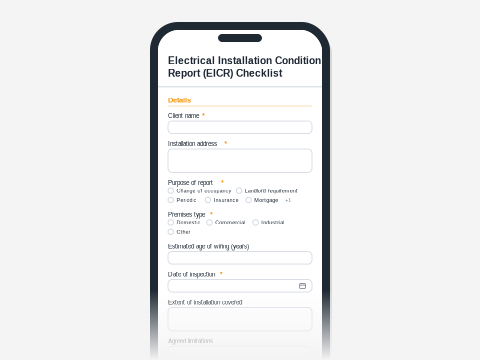 Electrical Installation Condition Report (EICR) Checklist
Site checklist for periodic inspection and testing: installation details, supply characteristics, inspection schedule, circuit test results and observations coded C1, C2, C3 or FI.
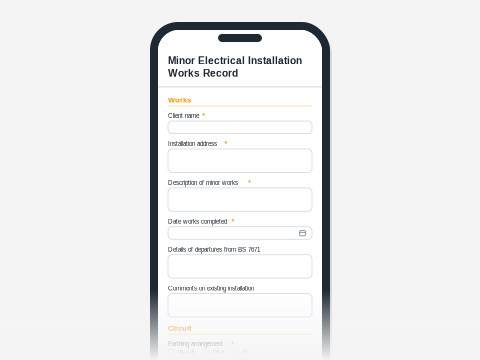 Minor Electrical Installation Works Record
Records the details of minor electrical works, such as an added socket or replaced circuit accessory, including circuit details and test results.
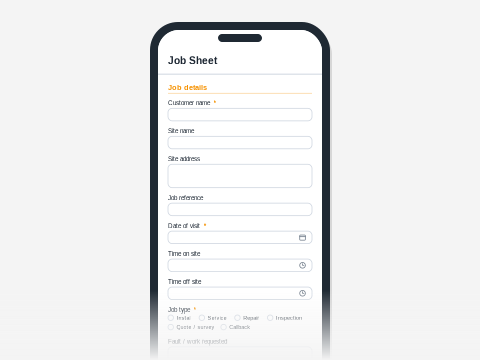 Job Sheet
Record a site visit: work carried out, parts and materials used, time on site, photos and customer sign-off.
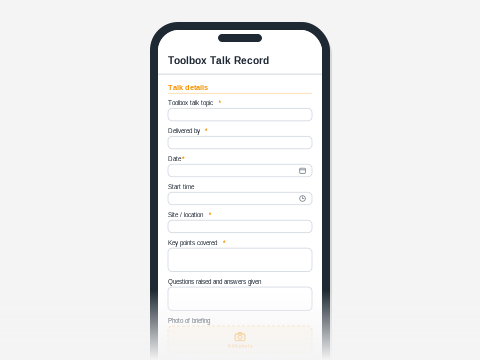 Toolbox Talk Record
Record the topic, key points and attendance of a toolbox talk, with each attendee signing to confirm they understood.