
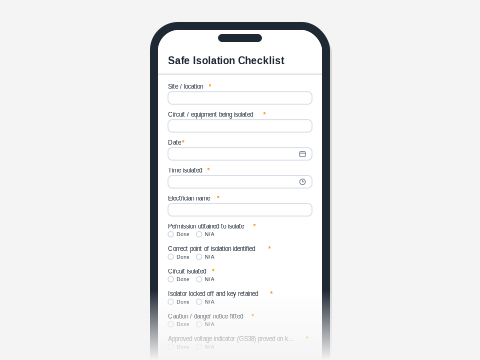
Safe Isolation Checklist template
Step-by-step safe isolation record: identify, isolate, lock off, prove the tester, test dead, re-prove and display warnings.
Opens in a free trial with this form ready to use.
Download printable PDF (60 KB)Electricity at Work Regulations 1989 (reg. 12-14); HSE GS38
This template is provided as a starting point only. pro-Forms accepts no liability for the accuracy or suitability of its forms. Check every form with a suitably qualified person before using it in a live environment.
About this template
A step-by-step record of safe isolation before electrical work. Record the location, the circuit or equipment, who is working and the time, then confirm permission to isolate, the correct isolation point, isolation, lock-off with the key retained, a warning notice, the voltage indicator proved on a known source, all conductors tested dead and the indicator re-proved.
Completing it for every isolation builds the habit and gives you a record that the procedure was followed.
What's on this form
Every field in the template, grouped as it appears on the phone. Required fields are marked *.
1. Isolation
- Site / location * Text
- Circuit / equipment being isolated * Text
- Date * Date
- Time isolated * Time
- Electrician name * Text
- Permission obtained to isolate * Done / N/A Choice
- Correct point of isolation identified * Done / N/A Choice
- Circuit isolated * Done / N/A Choice
- Isolator locked off and key retained * Done / N/A Choice
- Caution / danger notice fitted * Done / N/A Choice
- Approved voltage indicator (GS38) proved on known source * Done / N/A Choice
- All conductors tested dead (L-N, L-E, N-E) * Done / N/A Choice
- Voltage indicator re-proved on known source * Done / N/A Choice
- Lock number Text
- Voltage indicator serial number Text
- Photo of lock-off Photo
- Time re-energised Time
- Circuit tested and re-energised safely Yes / No Choice
- Electrician signature * Signature
Questions about this template
What is prove, test, prove?
Prove the voltage indicator works on a known live source, test the circuit is dead, then prove the indicator again to make sure it didn't fail during the test.
What does GS38 cover?
HSE guidance on test probes and leads: fused leads, finger guards and probe tips with minimal exposed metal, to protect against shock and arc flash.
Why lock off and keep the key?
So nobody else can switch the supply back on while you are working. A warning notice tells others why it is off.
More Electrical templates
All 16 templates →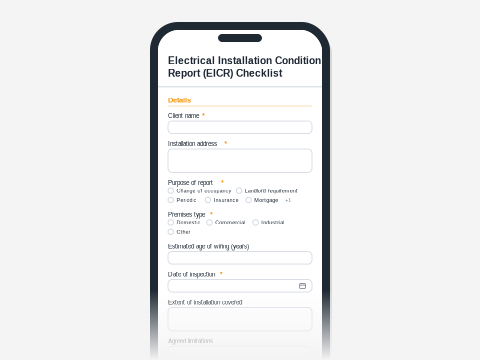 Electrical Installation Condition Report (EICR) Checklist
Site checklist for periodic inspection and testing: installation details, supply characteristics, inspection schedule, circuit test results and observations coded C1, C2, C3 or FI.
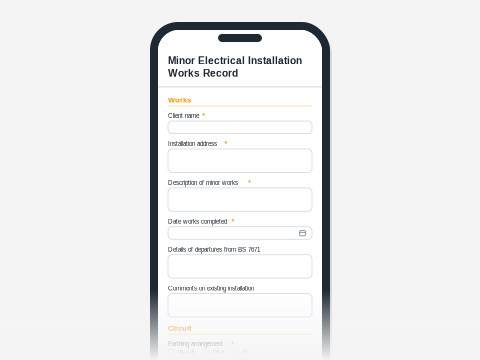 Minor Electrical Installation Works Record
Records the details of minor electrical works, such as an added socket or replaced circuit accessory, including circuit details and test results.
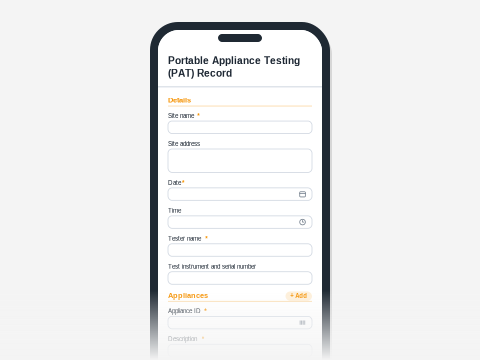 Portable Appliance Testing (PAT) Record
Appliance-by-appliance PAT record: ID, class, visual inspection, earth continuity, insulation resistance and result.
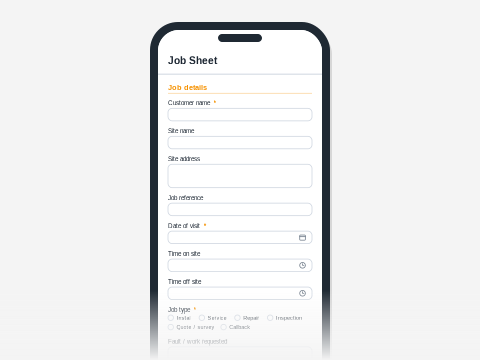 Job Sheet
Record a site visit: work carried out, parts and materials used, time on site, photos and customer sign-off.