
HVAC Form Templates
Service and compliance records for air conditioning, refrigeration and ventilation engineers: F-gas leak checks, refrigerant logs, AC service reports and air handling unit maintenance.
Capture pressures, temperatures and refrigerant quantities on site, and give customers the record they need for their F-gas log.
10 templates · 9 mobile · 1 online
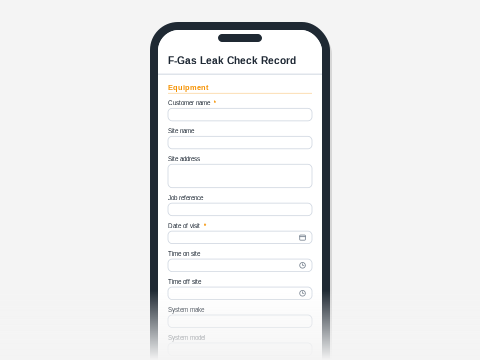 F-Gas Leak Check Record
Leak check record for refrigeration and air conditioning: refrigerant charge, CO2 equivalent, method, leaks found and repair.
Starter set
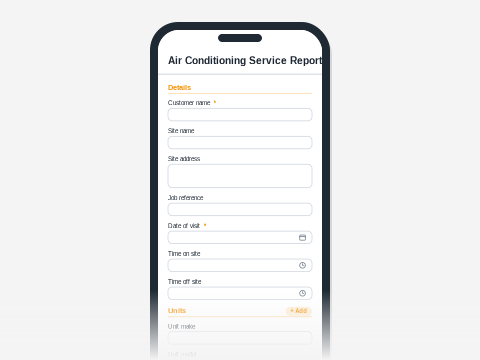 Air Conditioning Service Report
Planned maintenance of split or VRF air conditioning: filters, coils, drains, electrics, refrigerant pressures and temperatures.
Starter set
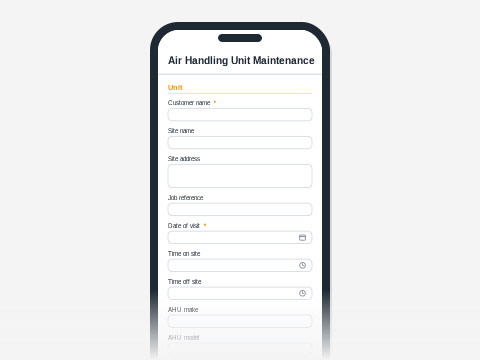 Air Handling Unit Maintenance
AHU planned maintenance: filters and pressure drop, belts, bearings, coils, dampers, drains, fans and controls.
Starter set
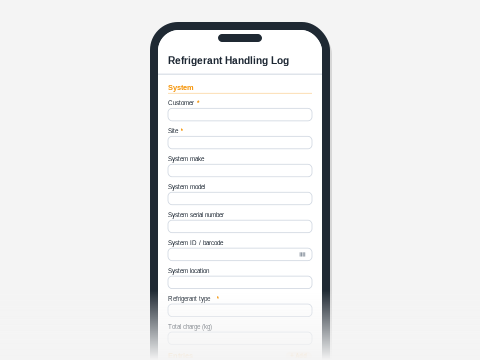 Refrigerant Handling Log
Running log of refrigerant added to or recovered from a system, with cylinder numbers and engineer details.
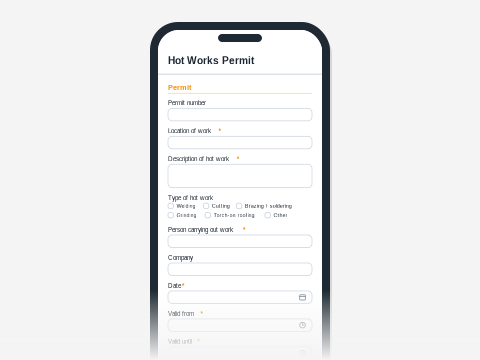 Hot Works Permit
Permit to control welding, cutting, grinding and torch-on work, with pre-work checks, fire watch and final sign-off.
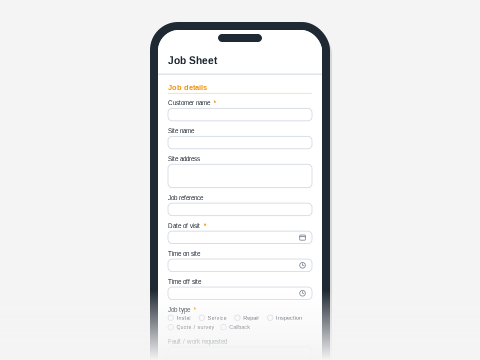 Job Sheet
Record a site visit: work carried out, parts and materials used, time on site, photos and customer sign-off.
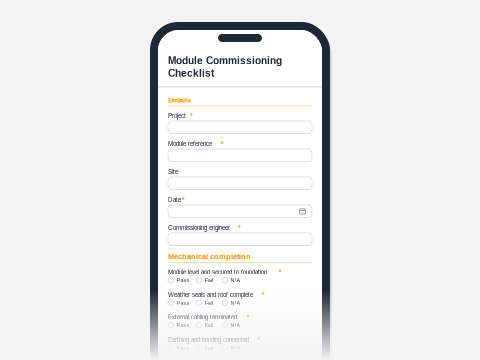 Module Commissioning Checklist
Site commissioning of an installed data centre module, from mechanical completion through integrated systems testing.
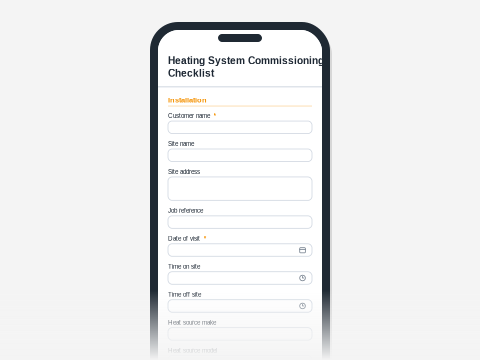 Heating System Commissioning Checklist
Commissioning record for a new boiler or heat pump: flushing, inhibitor, controls, readings and handover to the customer.
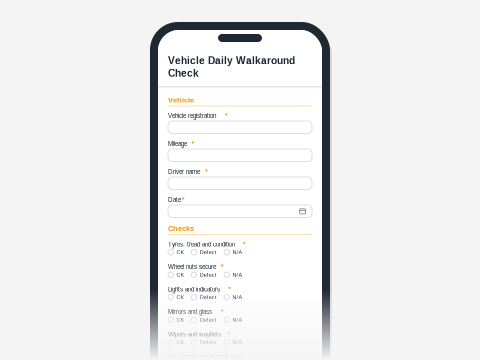 Vehicle Daily Walkaround Check
Driver's daily walkaround of a van or car: tyres, lights, mirrors, fluids, bodywork, load security and defects.
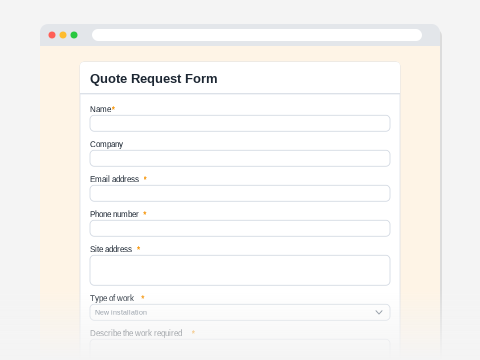 Quote Request Form
Customer request for a quotation: contact details, site address, work required, timescale, budget and photos.
Regulations these templates help you record
- GB F-Gas Regulation: in Great Britain the retained Regulation (EU) 517/2014 still applies. Systems of 5 tonnes CO2 equivalent or more need regular leak checks: every 12 months from 5 t, 6 months from 50 t and 3 months from 500 t; the intervals double (to 24, 12 and 6 months) where a leak detection system is fitted. Northern Ireland follows the EU Regulation 2024/573.
- F-gas records: operators must keep records of each system's refrigerant, quantities added and recovered, leak checks and who carried out the work, for at least five years.
- Energy Performance of Buildings Regulations: air conditioning systems over 12 kW need an energy assessment (TM44) at least every five years.
- SFG20: the industry standard maintenance schedules for building services, including AHUs and AC units.
HVAC template FAQs
How often does an air conditioning system need an F-gas leak check?
It depends on the refrigerant charge in CO2 equivalent: at least every 12 months from 5 tonnes, every 6 months from 50 tonnes and every 3 months from 500 tonnes. If a leak detection system is fitted, the intervals double.
How do I work out tonnes of CO2 equivalent?
Multiply the refrigerant charge in kilograms by the refrigerant's global warming potential, then divide by 1,000. For example, 10 kg of R410A (GWP 2,088) is about 20.9 tonnes CO2 equivalent.
Do the EU F-gas rules apply in Great Britain?
No. Great Britain still follows the retained 517/2014 Regulation; the EU's 2024 Regulation applies in Northern Ireland. Check which regime applies to the site you are working on.
How long must F-gas records be kept?
At least five years, by the operator of the equipment. Engineers commonly keep their own copies too.